
April 2026.
Bryan Groleau – Consumer Engagement Specialist
A Walk in the Georgia Woods
Our family recently ventured to the Georgia mountains for a few days of fresh air, open skies, and the kind of slow, unhurried time together that has become increasingly rare in modern life. We needed this. The kind of reset that only nature can offer — no notifications, deadlines, or noise outside wilderness in the woods. There is something quietly powerful about stepping off a trail into a stand of hardwoods. The sound of wind through bare branches, the crunch of dried leaves underfoot, the sun finding its way down through the canopy — it grounds you in a way that nothing else quite does. For a few hours, the world outside those trees simply did not exist.
And then I saw the first bottle.
A clear plastic water bottle, blue cap still screwed on tight, sitting upright in the leaves as if someone had simply set it down and walked away. A few feet beyond it, another one — this one lying on its side, its label still readable despite what must have been months of exposure. I walked a little further. More plastic. A crumpled bottle half-buried under the leaf litter. A shotgun casing here and there. Fragments of packaging. The quiet that I had been savoring just moments before now felt heavy with something else.
I took out my phone and started photographing what I was seeing. Not because I wanted to document the ugliness, but because I knew that when I got home, I would want to talk about it — and some things need to be seen to be understood.
The Uncomfortable Truth About Plastic
What I found in those Georgia woods was a symptom of one of the most significant environmental crises of our time — one that persists despite decades of public awareness campaigns, recycling programs, and well-intentioned effort.
Here is the reality: of all the plastic ever produced, less than 10% has been recycled. The rest has been incinerated, sent to landfills, or released into the environment. Every year, an estimated 8 to 10 million metric tons of plastic enters the world's oceans. That isroughly equivalent to dumping a garbage truck full of plastic into the sea every single minute of every single day. Yet, plastic production not only persists but accelerates. Globally, humans produced more plastic in the first decade of this century than in all of
the previous century combined. The majority of that plastic is single-use — designed to be used once and discarded. Packaging. Bottles. Containers. Convenience.
The problem is not simply one of bad behavior or careless individuals — though that certainly contributes. The deeper issue is that the material itself, the plastic, was never designed with its end-of-life in mind. A conventional plastic water bottle will remain in the environment for 450 years or more. It does not disappear; it breaks down into smaller and smaller particles — microplastics — that infiltrate soil, water, and living organisms, including us.
Why Recycling Alone Will Never Be Enough
For a long time, many of us held on to the belief that recycling would save us from the plastic problem. We sorted our bins, rinsed our containers, and trusted that the system would take care of the rest. That faith, while well-meaning, was misplaced.
Recycling infrastructure, even in developed nations, is inconsistent and insufficient. While many types of plastic are technically recyclable, they are economically unviable to process. Contamination — food residue, mixed materials, non-recyclable items placed in recycling bins — renders entire batches of material un-processed. And in many parts of the world, particularly in developing nations that became destinations for exported recyclable waste, the infrastructure to handle this material simply does not exist.
The hard truth is that recycling, as it currently functions, is a downstream solution to an upstream problem. We are trying to manage the consequences of a material that was fundamentally designed without sustainability in mind. While recycling programs reduce the volume of plastic waste that reaches landfills and waterways, but have not — and cannot — solve the problem on their own.
The plastic bottles I found in those Georgia woods were proof of that. Whatever system was supposed to capture and recycle them had failed — or those items had simply never been part of that system at all. There they were, among the leaves and the roots and the winter light, where they would remain, largely unchanged, for generations.
What Plastic Is Doing to the Planet We Love
The consequences of unchecked plastic pollution reach far beyond the visual. They are biological, ecological, and ultimately existential for thousands of species.
Marine life suffers the most visibly. Sea turtles mistake plastic bags for jellyfish. Seabirds feed plastic fragments to their chicks, filling small stomachs with material that provides no nutrition and cannot be digested. Whales and dolphins become entangled in discarded fishing gear or ingest so much plastic that their digestive systems shut down. Over 700 species of marine animals have been documented encountering plastic debris.
But the impact does not stop at the water's edge. Terrestrial ecosystems are affected as well. The Georgia forest I walked through is part of a broader watershed. Rain washes plastic debris from the forest floor into streams and rivers, which carry it toward the coast. The journey from a woodland path to the open ocean is shorter than most people realize.
And then there is the microplastic crisis — perhaps the most insidious dimension of all. As conventional plastics break down, they fragment into particles small enough to be invisible to the naked eye. These particles have been found in the deepest ocean trenches, in Arctic ice, in the blood of fish, in human breast milk, and in our own bloodstream. We are, quite literally, ingesting the consequences of our packaging choices.
Standing in the Woods, Thinking About Solutions
As I stood there among the leaf litter, I found myself thinking about the plastic problem from both ends. What happens after plastic enters the environment is catastrophic and slow — but what if we changed what entered the environment in the first place?
That question is the heart of PAC-LITE.
We are not naive about human behavior. Litter happens. Waste escapes the systems designed to contain it. No matter how robust recycling programs become, some portion of packaging will always find its way into places it was never meant to go — into forests, into rivers, into the natural spaces where families go to disconnect and breathe. We know this.
The question is: when that happens, what then?
PAC-LITE: Packaging Designed for the Real World
PAC-LITE represents a fundamental rethinking of what packaging can and should be. It is the first option available to offer consumer goods packaging with a meaningful answer to end-of-life — not through a recycling program that may or may not function, but through the material itself.
PAC-LITE packaging is designed to biodegrade. Not in the vague, aspirational sense that sometimes gets attached to marketing claims, but in a genuine, material sense: if PAC- LITE packaging ends up in the environment, it breaks down and returns to the earth. It does not linger for centuries. It does not fragment into microplastics that infiltrate the food chain. It becomes part of the soil from which it came.
Let me be clear about something important: we do not want to see PAC-LITE packaging discarded in the woods. The ideal outcome is always responsible disposal, and we encourage every consumer to handle packaging thoughtfully. We know that the world is imperfect, that systems fail, and that the only truly responsible packaging is packaging that accounts for what happens when things go wrong.
When a conventional plastic bottle ends up in a Georgia forest, it will be there for your grandchildren's grandchildren to find. When a PAC-LITE container ends up in the same place, it begins the process of returning to the earth — quietly, harmlessly, completely.
That is not a small difference. That is the difference between a material that poisons an ecosystem for generations and one that participates in the natural cycle of life and decomposition that the forest depends on.
Better Choices Begin Before the Purchase
One of the most important shifts we can make as consumers is to recognize that our choices have consequences that extend far beyond the moment of use. When we pick up a product at the store, we are not just choosing a product — we are choosing a packaging material, and that material will exist in the world long after the product is gone.
Choosing PAC-LITE is an act of forward-thinking. It is an acknowledgment that what we buy matters, how things are made matters, and what happens to the materials when we are done with them matters. It is not a perfect solution — no single solution exists for a problem as complex as global plastic pollution. But it is a meaningful one. It is a choice that reduces harm, that accounts for the real behavior of real people in the real world.
For brands and manufacturers, choosing PAC-LITE is a statement to your customers: we see the problem, we take it seriously, and we have taken concrete steps to be part of the solution. In a market where consumers are increasingly paying attention to the environmental impact of the products they buy, that is not just the right thing to do — it is also the smart thing to do.
Back to the Woods
Our family enjoyed an idyllic escape in the woods of the Blue Ridge Mountains as we carved out space and time to surround ourselves in the beauty in nature. Whether gazing at endless stars and constellations, searching of the perfect walking stick, building a campfire, or hiking alongside waterfalls, our moments in the woods served as an ever-present reminder of the world is a place worth protecting. The images of bottles littered amongst the leaves remain evidence of a problem that no amount of optimism can simply wish away, but one that calls to action.
We go to nature to remember what matters. We walk through forests, along riverbanks, and into open fields to reconnect with a primitive peace outside the noise and business of our daily lives. When we find discarded plastic in those places, it is the planet asking us to pay attention to something else entirely. It is asking us to consider the choices we make with the products we buy and in the packaging we accept.
PAC-LITE is built on the belief that better choices are possible. Packaging should be as thoughtfully designed as the product itself.
It starts with a choice. Make yours.
From the Forest Floor — Georgia, 2026
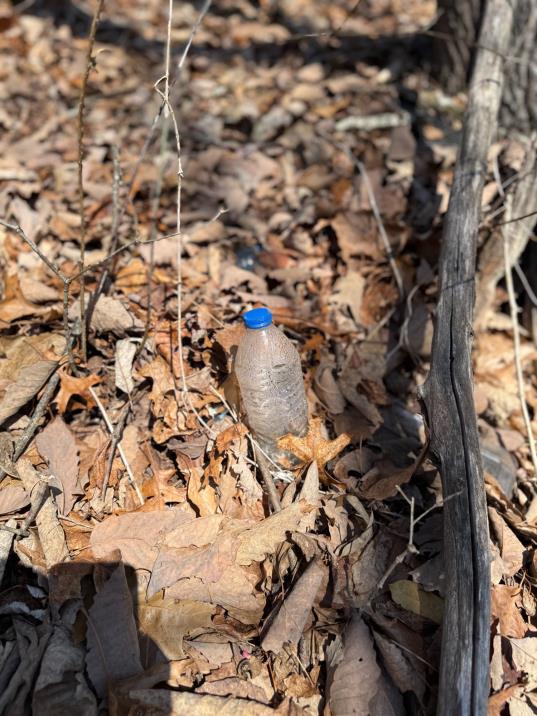
A plastic water bottle found standing upright among the leaf litter.
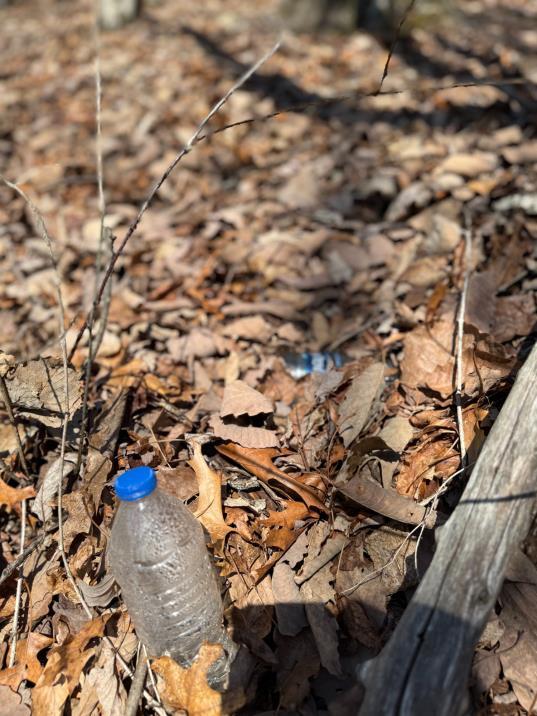 Multiple bottles visible along the same stretch of forest path.
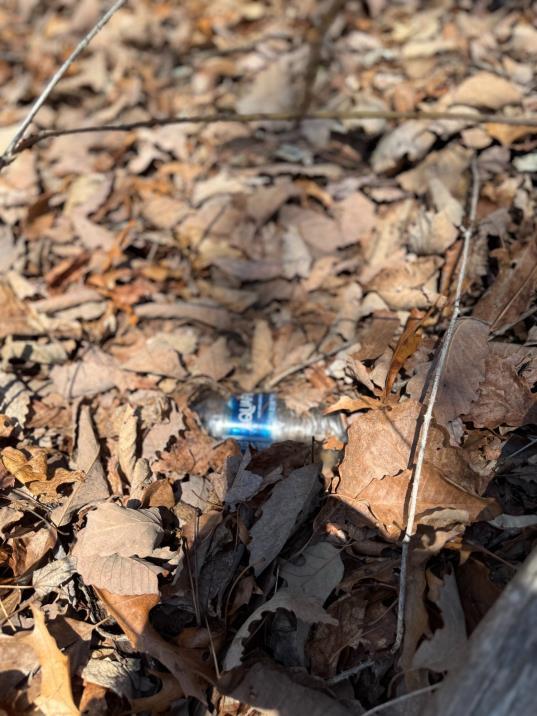
A bottle on its side, partially submerged in the leaf litter — blending into the forest floor.